
Description:
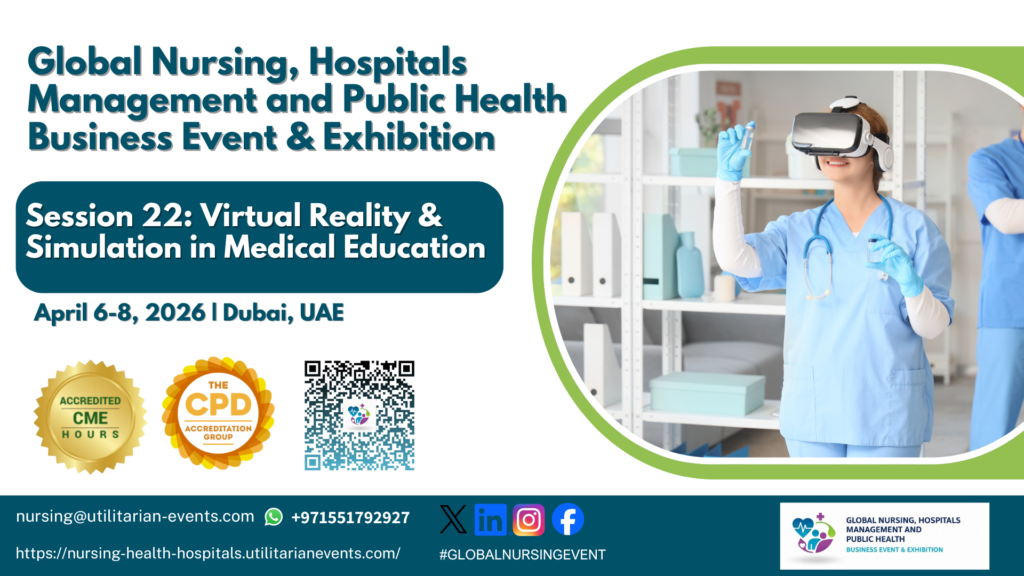
Virtual Reality & Simulation in Medical Education explores the use of immersive technologies and realistic simulation to enhance the training of healthcare professionals. This approach enables learners to practice clinical skills, procedures, and decision-making in a controlled, risk-free environment, improving competence, confidence, and patient safety. By integrating virtual reality, augmented reality, and high-fidelity simulation into curricula, medical education becomes more interactive, standardized, and accessible. It supports interprofessional learning, objective performance assessment, and scalable remote training, preparing future healthcare providers for the evolving demands of modern, technology-driven clinical practice.
Upload here: https://nursing-health-hospitals.utilitarianevents.com/upload-presentation/
WhatsApp: https://wa.me/+971551792927
Email: nursing@utilitarian-events.com
Keynote Points:
Transforming medical education through immersive, technology-driven learning environments
Enhancing clinical skills training with realistic, risk-free simulation experiences
Improving procedural competence, decision-making, and critical thinking
Standardizing medical training and assessment across institutions and specialties
Integrating virtual reality, augmented reality, and high-fidelity simulation into curricula
Benefits:
Enhances clinical competency through hands-on, immersive, and experiential learning
Improves procedural accuracy, confidence, and clinical decision-making
Provides a safe, risk-free environment for skill practice and error correction
Supports standardized training and objective assessment of learner performance
Accelerates learning curves and improves knowledge retention
Facilitates interprofessional collaboration and team-based training